A custom, responsive website is one of the few business investments that keep earning long after it’s built. It’s shaped around your business and your brand, works on every screen, and adapts as the business changes.
Your website is the first thing a serious prospect looks at. It’s where deals start, where credibility is judged, and where your competitors are also showing up. A site that loads slowly, looks generic, or breaks on a phone tells the visitor more than you’d like it to.
What Is Responsive Website Design?
Responsive website design is an approach where one website adjusts its layout, content and functionality to suit whatever device it’s being viewed on. It works by using flexible grids, fluid images, and CSS rules that respond to screen width.
The point is straightforward. Your site should look right and work well on a phone, a tablet, a laptop, and a 27-inch monitor, without you maintaining four separate versions.
Mobile traffic now outweighs desktop traffic across most industries. According to Statcounter (2025), mobile devices account for around 58% of global web traffic. A site that doesn’t behave well on a phone is a site that’s losing customers before they ever read a word.
What Is a Custom Website?
A custom website is one made to meet the needs and branding requirements of a specific business. It works by starting with your goals, your audience and your brand, then making design and technical decisions that serve those things directly.
That means the structure of the site reflects how you actually sell, support and grow. The look and feel carry your brand consistently across every page and every screen. The functionality matches what your team and your customers need to get done. Nothing generic, nothing approximated.
A custom website gives you a starting point and room to grow.
Why Custom and Responsive Work Better Together
Most modern websites are responsive by default. That part is settled. What separates a great custom and responsive build from one that just ticks boxes is intent.
When a site is custom-built and responsive from the start, every decision serves your business. The mobile layout isn’t a compressed version of the desktop, it’s its own considered design. Navigation reflects how your customers actually look for things. Integrations with your CRM, booking system or product feed are built to work, not bolted on later.
A site that’s been styled to look like your brand is one thing. A site that has been designed around your brand from the first sketch is another. Customers can feel the difference, even when they can’t name it.
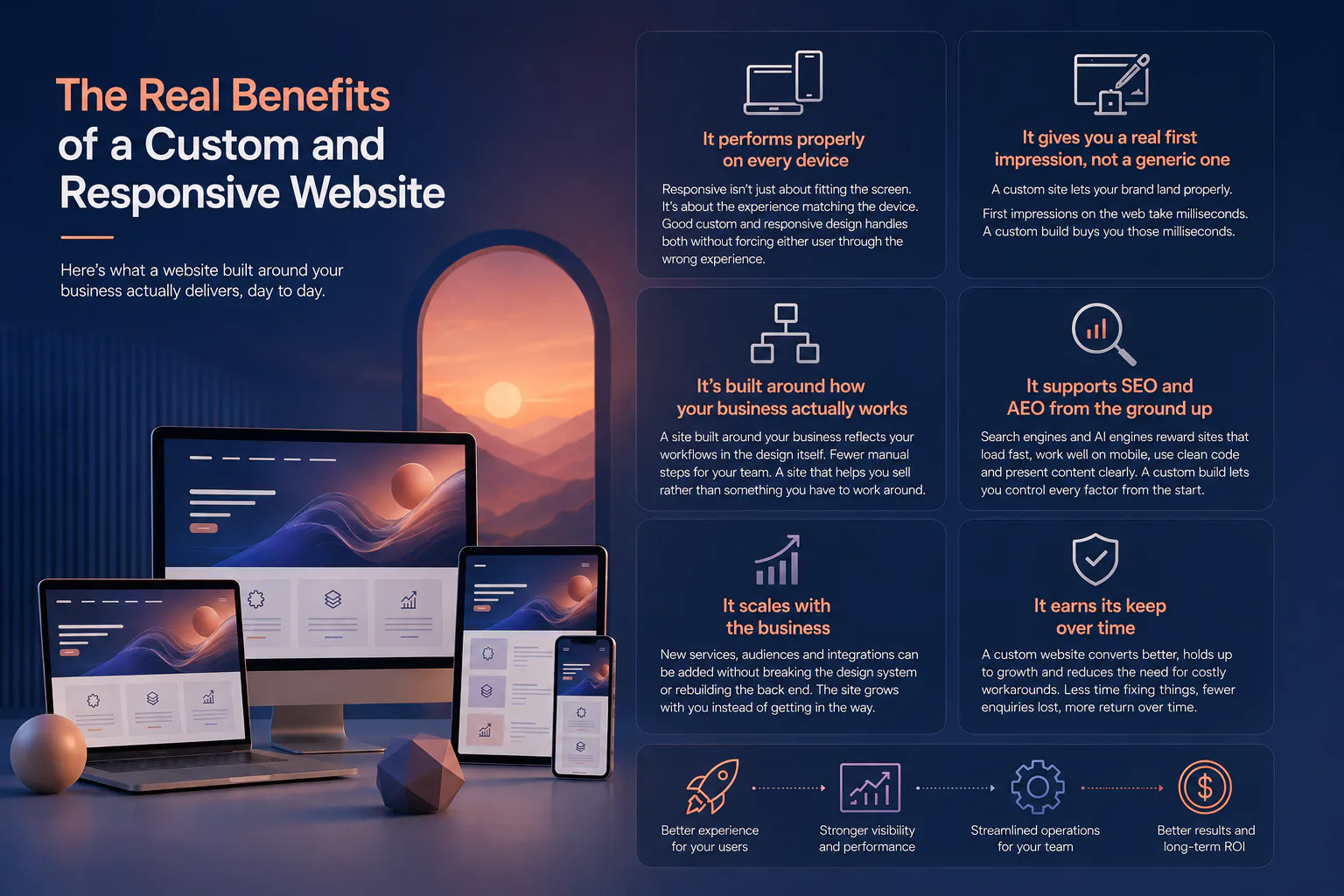
The Real Benefits of a Custom and Responsive Website
Here’s what a website built around your business actually delivers, day to day.
It performs properly on every device
Responsive isn’t just about fitting the screen. It’s about the experience matching the device. A phone user wants to tap a number and call you. Someone on a desktop might want to read a longer case study before making a decision. Good custom and responsive design handles both without forcing either user through the wrong experience.
It gives you a real first impression, not a generic one
You wouldn’t fit out your office with stock photos and someone else’s logo. The same standard should apply to your website. A custom site lets your brand land properly. Typography, colour, spacing, motion, voice. All of it carries the weight of your business, the way you’d want it carried.
First impressions on the web take milliseconds. Visitors decide whether a site looks credible before they read a single sentence. A custom build buys you those milliseconds.
It’s built around how your business actually works
Every business has its own way of taking enquiries, qualifying leads, displaying products, managing bookings or supporting customers after the sale. A site built around your business reflects those workflows in the design itself. Forms ask the right questions. Product pages surface the information your customers actually want. Booking flows match how you run things, not the other way around.
Fewer manual steps for your team. Fewer awkward workarounds. A site that helps you sell rather than something you have to work around.
It supports SEO and AEO from the ground up
Search engines reward sites that load fast, work well on mobile, use clean code and present content clearly. AI engines extracting answers for users do the same. A custom build lets you control every one of those factors, because every decision is made deliberately rather than inherited from someone else’s defaults.
According to Google’s Core Web Vitals guidance, page experience signals like loading, interactivity and visual stability directly affect rankings. These are engineering decisions, and they’re easier to get right when the site has been built with them in mind from the start.
It scales with the business
Most businesses don’t look the same in three years as they do today. New services, new audiences, new integrations, new markets. A custom and responsive website is built with that in mind. New sections can be added without breaking the design system. New integrations can be wired in without rebuilding the back end. The site grows with you instead of getting in the way.
If you’re planning to grow, the site needs to be planned for growth. That’s a custom job.
It earns its keep over time
A custom and responsive website is a meaningful upfront investment. The return shows up later, in the form of a site that converts better, holds up to growth, and doesn’t need expensive workarounds every time the business changes direction.
Because the site is built around what your business actually does, it does more of the heavy lifting for you. Less time spent fixing things, less money spent on patches and plugins, fewer enquiries lost because something didn’t quite work. You can read more about how we think about cost on our website design page.
Why Does Website Speed Affect Conversions?
Page speed is one of the clearest links between technical design and business outcomes. According to Google/SOASTA research published on Think with Google (2017), the probability of a bounce increases by 32% as page load time goes from one second to three seconds, and by 90% as it goes from one second to five seconds.
Speed is partly a hosting question and partly a code question. A custom build lets you optimise both, because every script, image and asset on the site is there on purpose. Nothing loads that doesn’t need to. Nothing’s bolted on because it came with the kit.
If a site is slow, every other investment works harder for less return. Paid ads, SEO, email. All of it. Fixing speed is the cheapest conversion-rate optimisation most businesses can do.
What to Expect When You Invest in a Custom Build
A serious custom and responsive website project usually runs in four broad stages.
Discovery and strategy. This is where the agency learns your business. Goals, audience, what’s working, what isn’t, what success looks like. Skip this stage, and the rest of the project is guesswork.
Design. Wireframes first, then visual design. Done properly, this stage produces a site that’s been thought through at every screen size before a single line of code is written. Our UX and user experience design work sits here.
Development. Building the thing. A good developer makes the design real without flattening it, hooks up the integrations cleanly, and writes code that the next developer can read.
Launch and support. Going live is the start, not the finish. Sites that get looked after stay fast, secure and effective. Sites that don’t, drift.
Common Misconceptions About Custom Websites
A few things we hear regularly that are worth addressing directly.
“Custom takes too long.” It takes longer than the cheapest option, yes. But “long” depends on what you’re measuring. The site that lands properly and supports the business for five years is faster, in the only sense that matters, than one rushed out in a fortnight and rebuilt eighteen months later.
“Custom is only for big companies.” Not in our experience. Small and mid-size businesses get a disproportionate benefit from custom builds because the site does more of the heavy lifting for them.
“We can just rebuild it in a few years.” You can. Most businesses don’t, because rebuilding is disruptive and expensive. Buying right the first time is usually cheaper than buying twice.
How to Tell if You Need a Custom and Responsive Website
A few honest questions to ask:
- Is your current site costing you enquiries or sales?
- Does it look the way you’d want a serious prospect to find it?
- Does it work properly on a phone, end to end?
- Can you make changes without paying a developer for every small update?
- Does it integrate with the tools your team actually uses?
If you’re answering no to two or more, the site is holding the business back. A rebuild pays for itself faster than most owners expect.
Where to From Here
A custom and responsive website isn’t a cost. It’s a piece of business infrastructure that earns its keep every day it’s online. If your current site is slowing the business down, the question isn’t whether to invest, it’s how soon.
If you’d like to talk through what a custom and responsive build would look like for your business, we’re happy to have that conversation.
Talk to us about your website.